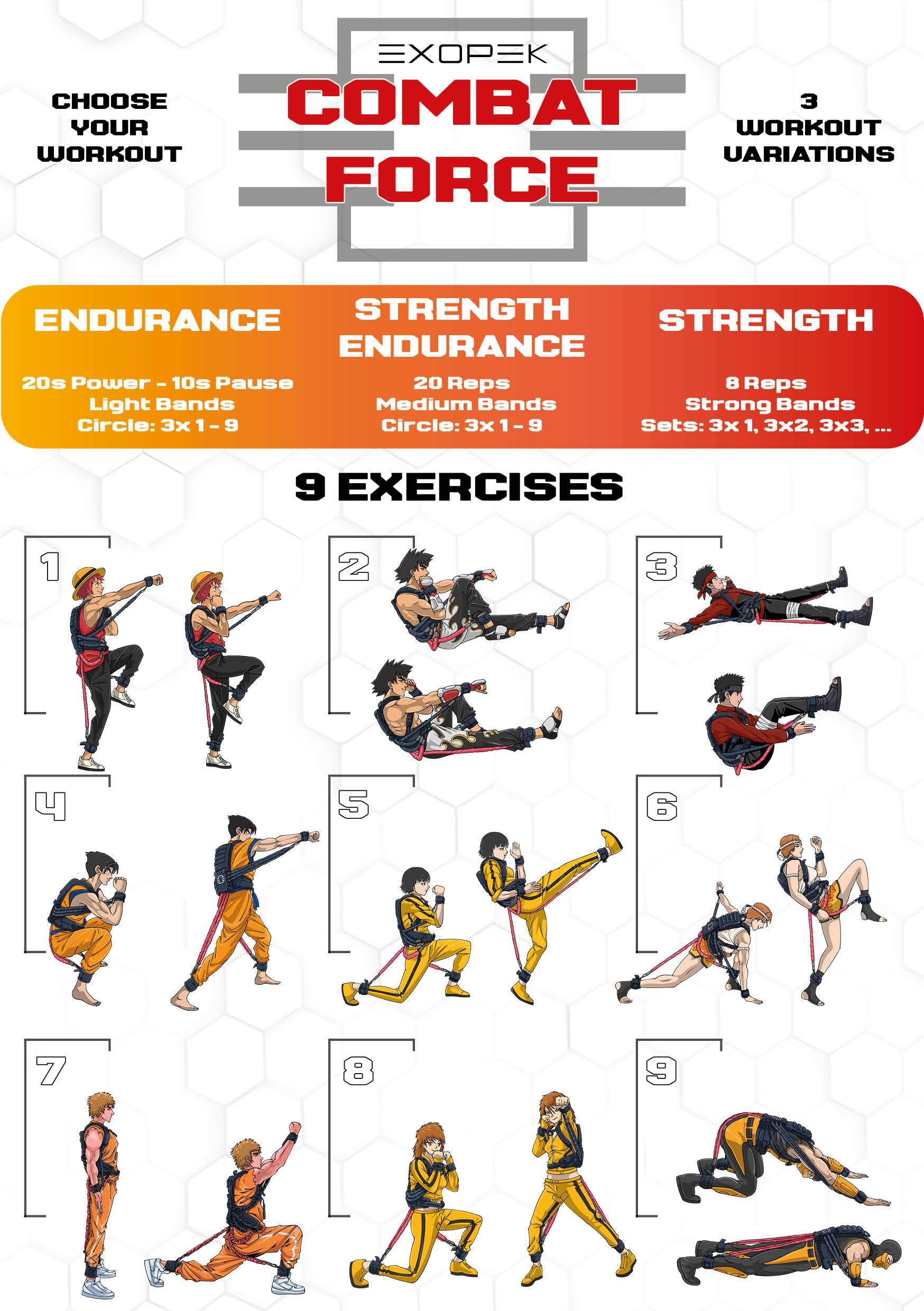
In recent years, the concept of functional training has become firmly established in the world of sport and is now a fundamental part of training. There are many studies that show that functional training, in contrast to traditional training on machines, offers added value for people of all ages and training levels. Whether young or old, trained or untrained: Functional training has a significant impact on physical development, helping you to surpass yourself, feel all-round fit and complete your everyday tasks more easily. More and more fitness studios are also focusing on functional areas. There is a good reason for this change: functional training is good for the musculoskeletal system, promotes mobility and coordination, prevents imbalances and has so many more positive effects.
Functional training offers a variety of benefits that go beyond training individual muscles. The most important benefits are
Machine training has the disadvantage that the movements are often rigidly guided and have little relevance to everyday life away from the equipment. Isolated movements can promote imbalances as they are often one-sided and hardly promote natural movements. Support muscles and stability remain largely untrained as the machines take over these tasks. Nevertheless, machines do offer some specific advantages, even if these are usually less relevant to everyday life:
Targeted muscle targeting: Machines can be useful for strengthening individual muscle groups, which can support more specific training goals.
Safe and controlled movements: Machines provide guided movement, which can be helpful for people with certain physical limitations or in rehabilitation, as they support stability.
Additional option for training variations: They also offer experienced exercisers the opportunity to supplement their workout if targeted muscle isolation is desired.
The term "function" is closely related to purpose and intention. In terms of sports science, functional training means that it is goal-oriented training that is close to what the exerciser needs, contains exercises with a certain purpose and can be considered task-based fitness. To put it simply: Functional training is designed to help you increase your fitness. Well, that's what all training is supposed to do, isn't it?

While machine training targets isolated muscles, functional training focuses on complex movement patterns that work the whole body. An important aspect of why functional training in particular is good lies in its origins in functional gymnastics. As early as the 1970s and 1980s, functional gymnastics was seen as an essential part of sport. Even then, the focus was on movements that lead to functional and morphological changes in the organism. Sports and training scientists quickly established that functional gymnastics in particular exerts beneficial stimuli on organs, joints and muscles, helps to coordinate movements and develop a good psychomotor basis for performing movements.
No matter what abilities, skills, goals or special requirements a trainee brings to training, one thing is certain: we never sit in fixed machines in everyday life, we always move in an open movement structure and complex movements. Isolated exercises, such as those trained in machines, are not found in everyday life.
As already mentioned, the aim of functional training is to promote mobility and coordination, prevent imbalances and strengthen the musculoskeletal system. It is about training the body holistically and not just working certain muscle groups in isolation. The body and muscle tone should be considered as a whole rather than in many small anatomical sections. The often missing everyday stimuli such as climbing stairs, long walks or monotonous work at a desk in the wrong posture should be counteracted by integrating complex movements relevant to everyday life. In addition to the sport-specific requirements of athletes, functional training is primarily about reproducing movements that are relevant to everyday life. Muscle fibers and collagen connective tissue structures as well as the fractal structure of the fascia and sensorimotor function should be strengthened in line with these requirements. It is important to note that functional training, in contrast to training on machines, moves in multidimensional planes and always challenges several muscle groups in a single exercise.
In summary, functional training is a method that focuses on improving physical health and fitness by integrating complex movements that are relevant to everyday life. It enables individual adaptation to the goals
Even the seemingly simplest everyday movement is multifaceted, multidimensional, takes place simultaneously on several levels and places complex demands on the body and mind. It is therefore important, as in our functional concept, to set training stimuli on all levels, to train everyday functions and thereby counteract back pain and possible illnesses. Training that is geared towards these complex stresses is therefore necessary. Training concepts that are designed for isolated muscle training on machines are outdated and not adapted to modern knowledge and the requirements of modern people.
Unfortunately, however, many trainers and athletes still believe that strength is the key to training. Unfortunately, they neglect the fact that our anatomy is designed for multiple planes of movement at all levels.
A little fact in passing: according to Erhardt (2012, p. 5 - 25), very few people have a strength problem. Rather, what concerns us is a functional problem.
Erhardt, D. (2012). Practical handbook of functional training. Stuttgart, New York: Thieme Verlag.
In general, mobility is a fundamental function that enables us to move sensibly at all. It makes a major contribution to the effortless completion of everyday activities that require a minimum of mobility. Perhaps you know it yourself when your shoulder feels stiff and even putting on tops is painful, or when everyday housework becomes a torture due to back pain. Mobility has a positive effect on general living conditions and can reduce the risk of injury. However, the general requirement for mobility has been lost in modern everyday and working life. We sit too much, walk too little and often have poor posture. All of this has a negative effect on the musculoskeletal system. As a result, we often find shortened hip flexors, poorer mobility, shoulder and back pain. If we do not train against this development, the human body adapts to this disuse in a biomechanical, degenerative process. This results in the degeneration of muscle, connective and supporting tissue in the area of the joints, joint capsules and joint surfaces.
That's why the motto is: move, move, move. With our functional concept, we promote precisely this movement in a natural way. Functional mobility training is also a scientifically irreplaceable element in any training process. It is an important core area of health, prevention and fitness training.
Although mobility is therefore a fundamental prerequisite for human motor skills and the quality of movement in everyday life, it is completely disregarded in training on machines. In this respect, functional concepts focus on mobility. This is because the isolated training of a single muscle and the pure increase in muscle mass places limits on joints and therefore mobility.
Functional mobility training is the most efficient way to counteract falls in everyday life or twisting an ankle, for example.
Gary Gray, a well-known physiotherapist, introduced a new way of looking at movement and muscle function back in 1990. In his concept of functional anatomy, he focuses less on individual muscles and more on the interconnectedness of muscles and joints in complex chains of movement. The human brain works in movements and not in the control of individual muscles. Therefore, training should also be thought of in terms of body systems and mobility and movement should be considered as core factors.
In today's everyday life, there is an increasing lack of sensory stimuli, which leads to a decrease in the training status of the connective tissue, the involuntary neuromuscular reactions and the stabilizing muscles. The main aim is to train the mobility of the complex muscle chains as a whole rather than a single muscle in its mass. Training the muscle chains is an important factor in health and should not be separated from training mobility. Muscle chains are particularly important in connection with the even, muscular development of agonists and antagonists. One-sided muscle training leads to the shortening of a muscle group and a reduced ability to stretch.
To illustrate the complexity of the interaction of synergists in complex muscle chains, we often talk about muscular imbalances or existing dysfunctions. These can be counteracted by training entire functional circuits. Intermuscular coordination, as the interaction of different muscles in a movement sequence, has a major influence on mobility.
John Myers critically questions the widespread view and definition of the muscle as a single unit and takes a major step towards new basic concepts. He breaks away from the widespread muscle concept and expands the view to a holistic concept that thinks beyond the isolated muscle. The focus is on training the complete muscle strands with the associated fasciae and anatomical traction lines.
It is important to emphasize that the body does not think in terms of individual muscles, but in terms of neuromotor units that comprise one to several hundred muscle fibres and are recruited in a coordinated manner, regardless of the muscle to which they ostensibly belong. Our generation is still stuck in the "muscle concept" - even after 20 years of constant efforts to eradicate this way of thinking.
In summary, it can be said that the training of mobility and muscle chains should be considered as a whole. One-sided muscular development can lead to imbalances and dysfunctions that ultimately restrict mobility and stability in everyday life. Functional training aims to support the entire body in its natural function rather than looking at individual muscles in isolation.
By training muscle chains, strength is distributed evenly and imbalances are prevented so that the body works more harmoniously and stably. Training the interplay of muscles and joints in functional movement chains ensures that the body is trained in its natural complexity. Especially in everyday life, this means greater independence, a lower risk of injury and an improved quality of life.
Ultimately, functional training offers an ideal combination of flexibility, strength and stability. It promotes functional and everyday fitness that goes far beyond purely muscular training. While machines often only focus on the muscle, functional training pays attention to the entire musculoskeletal system and thus creates a basis on which we can perform everyday tasks more effortlessly and safely. This is the key to sustainable and effective fitness that is tailored to the needs of modern life.